The Archive as Mirror
There is a particular kind of beauty that refuses to stay in its own century. It surfaces in a gesture repeated across paintings, in the cut of a sleeve that echoes something older than anyone living can name. This was the territory that Pathos Formulas chose to occupy - an exhibition and installation project presented by IED Istituto Europeo di Design at the ex-Teatro dell’Oriuolo in Florence during Pitti Uomo no. 110.
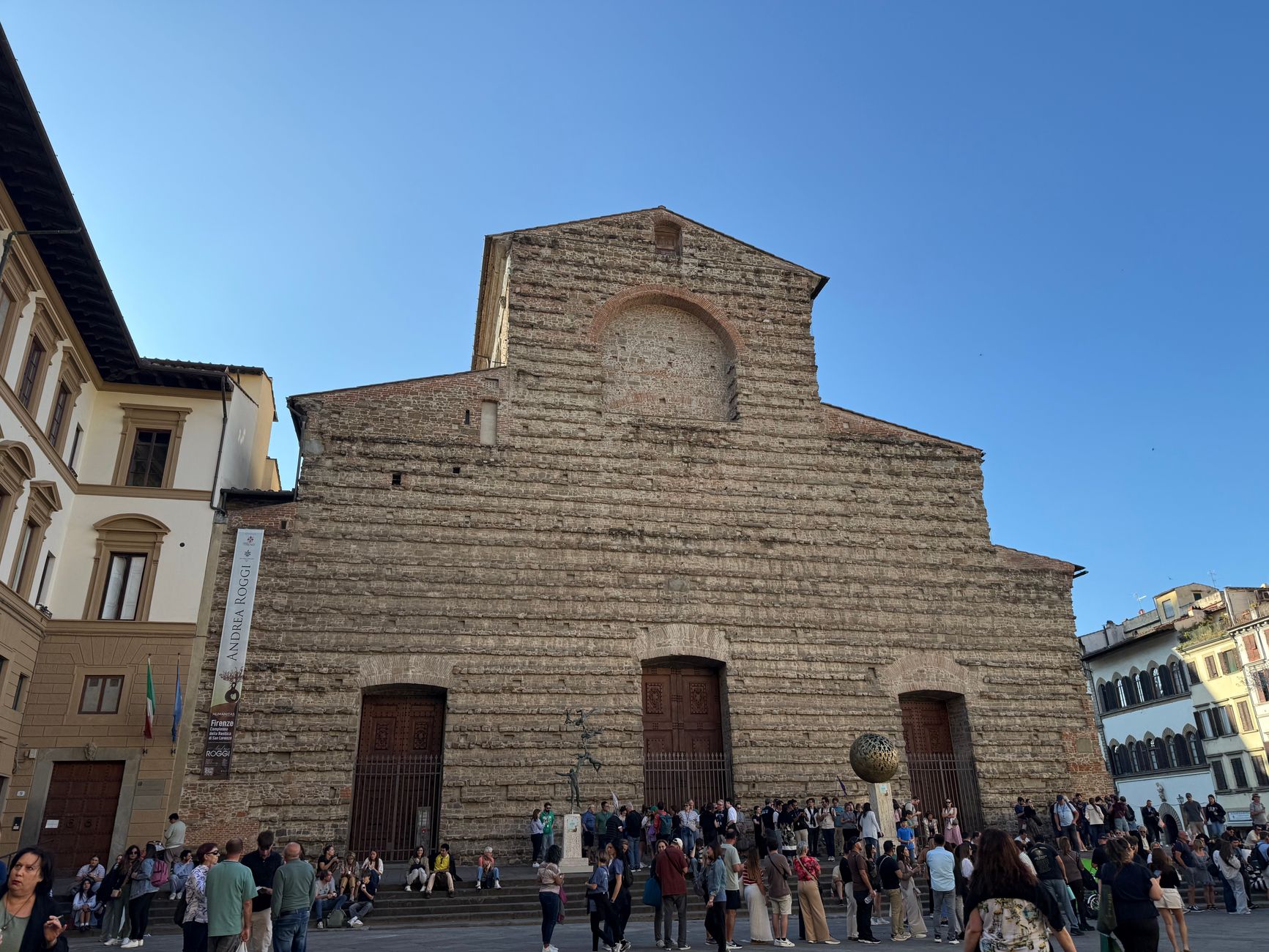
The venue mattered. Florence is, among other things, the city where art historian Aby Warburg developed his most radical thinking about how beauty transmits itself through time - how a gesture photographed in a Renaissance fresco can reappear, carrying its emotional charge intact, in a fashion photograph taken last week. The ex-Teatro dell’Oriuolo, a theatre stripped of its original function, became a research space where fashion, visual arts and editorial practices converged. Not a runway. Not a gallery in any conventional sense. Something closer to a working archive that visitors could walk through and feel pressing back.
Curated by Francesca Gavin - Editor-in-Chief of EPOCH Review, Director of Visual Arts at Murmur, and curator with credits including Manifesta 11, Somerset House, Palais de Tokyo and MU Eindhoven - the project brought together the work of 17 IED students across fashion design, styling, photography, graphic design, video, sound and interior design.
Beauty as Transmission, Not Invention
At the conceptual center of Pathos Formulas sits Warburg’s Pathosformel - the idea that certain expressive forms carry emotional and psychological weight across generations, migrating through cultures without losing their charge. Warburg was interested in why a specific posture or facial expression could appear in an ancient Greek relief and then resurface, essentially intact, in a Florentine altarpiece five hundred years later. The IED project extended that question directly into fashion: if beauty has a grammar, how does that grammar travel?
This is not an abstract question for anyone who has noticed that the silhouette dominating a current collection rhymes with something from three decades ago, or that a particular quality of light in a contemporary fashion photograph feels borrowed from Dutch Golden Age portraiture. History does not work linearly here. It folds, resurfaces, and borrows from itself with no obligation to acknowledge the debt.
Pathos Formulas treated history as precisely that - a non-linear structure. Symbols, motifs and visual forms migrate, layer, and re-emerge in new cultural contexts. What the exhibition asked its audience to consider was whether contemporary creative work is ever truly new, or whether it is always, at some level, a form of recognition - a meeting with something already encoded in visual memory.
Seventeen Students, Nine Research Clusters
The exhibition unfolded through nine research clusters developed by working groups of students. The transdisciplinary structure was deliberate: fashion design sitting alongside sound, photography in conversation with interior design. As IED Firenze Director Benedetta Lenzi described it, the project “takes shape through an open process built on relationships and connections between different time periods.”
That description carries more weight when you consider what Pathos Formulas was asking students to do. Beauty, in this context, was not a quality to be produced but a phenomenon to be investigated. The student work functioned as research tools - images, objects and spatial arrangements that moved between the recognizable and the not-yet-defined.
Gavin framed the project’s stakes plainly: the exhibition “highlights how our experience of the world around us is shaped by human history, and how the creative innovations of today can become part of a dialogue that continues across generations.” For students in fashion and design, that framing is quietly radical. It positions aesthetic choice not as self-expression alone but as participation in a much longer conversation - one that was already underway before anyone in the room was born, and will continue after.
Memory, Technology, and What Doesn’t Dissolve
Pathos Formulas arrived during IED’s 60th anniversary year, which the institution has organized around the theme Plural Intelligences. This theme runs through a public programme and the journal Notes on Plural Intelligences, whose third issue - titled Future Memories, featuring a piece by Francesca Gavin - was distributed at the ex-Teatro dell’Oriuolo during Pitti Uomo.
Future Memories provided the connective tissue between the journal and the exhibition itself.
The issue’s argument is that as artificial intelligence reconstructs cultures and histories, memory remains anchored in something technology cannot fully replicate: rituals of communion, shared stories, everyday acts of conviviality. Archives are, in this framing, not storage systems but living spaces where data and narratives meet to define not only how we remember, but why remembering matters. For beauty - which has always depended on a viewer’s capacity to recognize something, to feel it land - this distinction is not minor.
There is something specific at stake when AI systems begin generating images that look like fashion, that replicate the aesthetic codes of a decade or a movement, without any thread connecting them to the embodied, historical process that produced those codes. Pathos Formulas did not offer an answer to that problem. It posed the question spatially, through student work developed in Florence - a city where the weight of accumulated visual culture is present in every street corner - and let the tension sit.
Florence as the Inevitable Setting
Pitti Uomo no. 110 provided the immediate context, but Florence provided the deeper logic.
Warburg’s relationship to Florence was lifelong. He studied there, built his thinking about visual transmission partly in response to what he saw in Florentine churches and collections, and the city’s density of layered image-making - Byzantine, Gothic, Renaissance, Baroque - gave his ideas their testing ground. An exhibition built around Pathosformel staged in Florence is not coincidence. It is the project placing itself deliberately within the very geography that shaped the theory it is exploring.
For the 17 IED students whose work appeared at the ex-Teatro dell’Oriuolo, that context was available as both pressure and resource.
What Comes Next
A spin-off of Pathos Formulas is scheduled for October 22–25 as part of Ultra REF, the section of Romaeuropa dedicated to experimentation and the cross-fertilisation of different artistic languages.
The photographs from the Florence exhibition were taken by Stefano Casatti and Cristina Andolcetti.
Whether the work travels with the same charge it carried in Florence - in a city where Warburg’s ghost is practically a local resident - remains the open question Ultra REF will have to answer. Beauty built from citations and visual memory is always context-dependent. Move it, and something shifts.