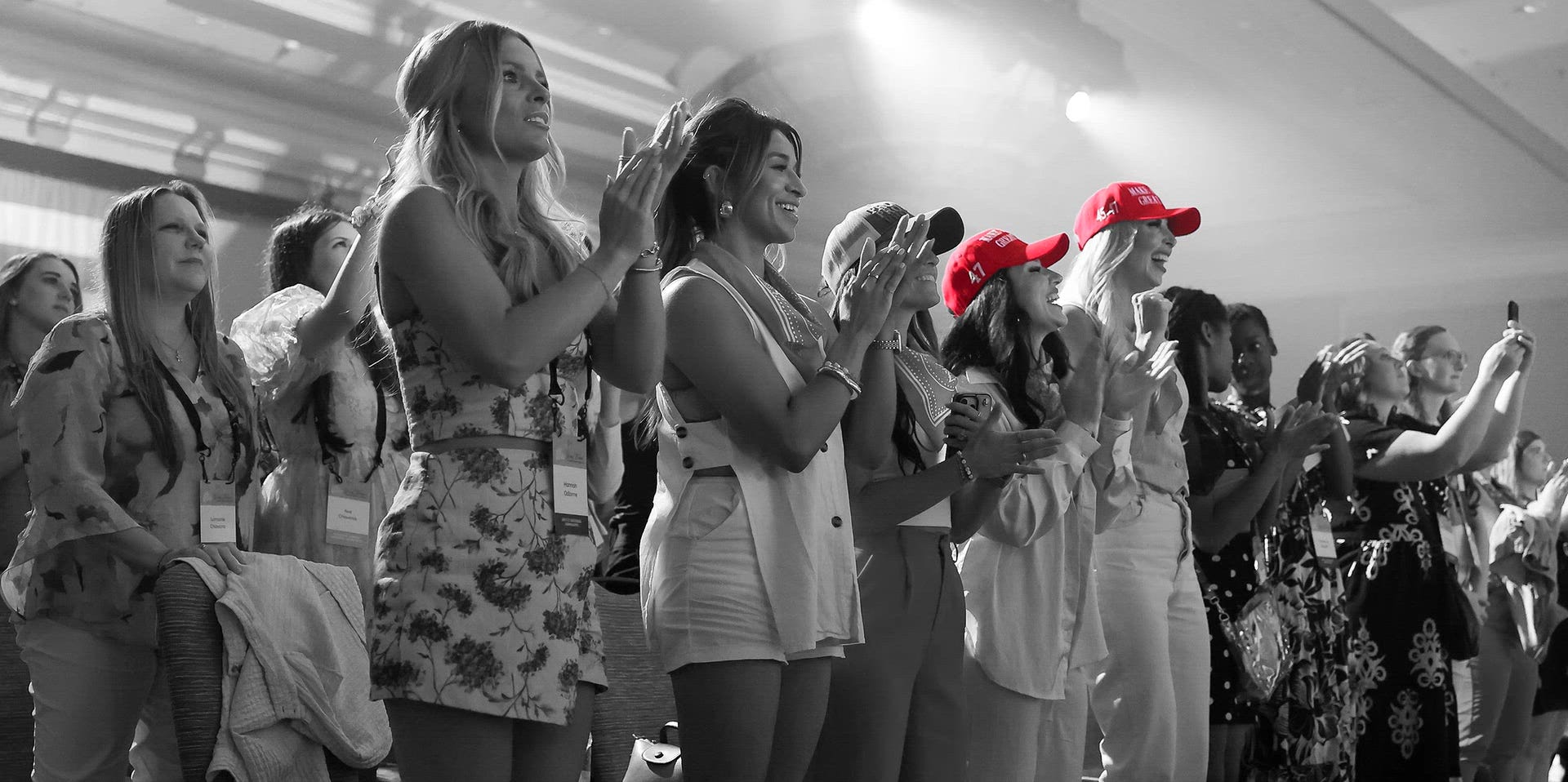
In the spring of 2026, at a three-day gathering of young Christian conservative women in San Antonio, Texas, a 21-year-old Florida influencer named Savanna Faith Stone took to the stage and told her audience something that made headlines for days afterward. Women, she declared, shouldn’t vote. Not because they lack the intelligence or the standing—Stone is careful to position herself as no one’s subordinate—but because the vote itself is a con: a gift from elites who never had women’s interests at heart, wrapped in the language of liberation and sold as progress. Her preferred alternative: “household voting,” or one ballot per family, cast by the husband, because husband and wife are “one flesh and one political unit.”
The clips spread quickly. At the Turning Point USA Women’s Leadership Summit, an event designed, with some irony, to recruit young women into conservative politics, several attendees told journalists that they would happily surrender their individual votes if it meant a more conservative country.
“If my husband’s the head of the household,” one woman told CBC, “I would imagine if he was voting on behalf of our household, I would be fine with that.”
What followed was a familiar media cycle: shock, mockery, a wave of think pieces positioning Stone as a fringe eccentric. And then, a week or so later, the story moved on. But the impulse to laugh and scroll past is precisely what the rhetorical strategy Stone deployed is designed to invite.
“These are reactionary statements that tend to do really well online,” says Jess Britvich, a former social worker who is now a content creator. Britvich focuses on the different ways the right uses the internet to promote anti-feminism and now anti-suffragism. “Inflammatory and emotionally provocative content does really well on the algorithm. This is why the right is so much stronger in online messaging,” Britvich explains. “They’re able to spread misinformation.”
This doesn’t always look dangerous. “It starts with women looking as though they are living these perfect, ‘traditional’ lives, in prairie-style dresses and playing with their kids,” Britvich continues, “and then later on, once that audience is captive, that is when they are able to convince women to go into these ideas.”
The podcast Culture Apothecary, hosted by Alex Clark, is funded by Turning Point USA. At the beginning of September, they launched their series Wife School, which gained wider attention, with their first episode promoting the idea that women should submit to their husbands, especially when it comes to sex. The guest on that episode, Tilly Dillehay, actually sells a course in becoming a “good” wife to a “godly” man, and Clark argues that a healthy marriage should not treat sex as optional.
The “Womanosphere” and Its Reach
The type of content that makes up the “womanosphere”—the term coined to describe the online ecosystem of antifeminist media and content creators—is outrageous enough to generate attention and just memorable enough that attention rarely hardens into analysis. But the claim that women shouldn’t vote is made not only by influencers like Stone, but also by powerful figures like pastor Doug Wilson, who has deep ties to the Trump administration and has told NPR that under a theocratic, patriarchal America, the 19th Amendment would be repealed. Last year, sociologists Paul Djupe and Brooklyn Walker polled a group of Americans about what they thought of women’s political rights. Of the respondents, 20.5 percent agreed or strongly agreed with the proposal for a household vote. There was a gender gap, however; 24.2 percent of men and 16.9 percent of women agreed.
When young women feel pessimistic about the future, influencers like Wilson and Stone offer something that sounds like relief.
Anti-suffragism and anti-feminism have strong and long links to each other, and ironically, women have been at the forefront of both movements. Savanna Stone has argued that the suffrage movement forced the vote upon women, many of whom, particularly those from working-class backgrounds, did not want it. Another anti-feminist, Rachel Wilson, has made a similar argument, adding that the true purpose of women’s suffrage was to get women to pay more taxes. None of this is supported by the historical record around suffrage movements, which included working-class, middle-class, and upper-class women. So why do these arguments resonate? Focusing on class divisions speaks to larger anxieties around affordability, the large number of women who left the American workforce post-Covid, and the shrinking of educational institutions, hospital workforces, and federal workforces—industries that traditionally provided women with not just jobs but the potential for career advancement and real power.
Why the Messaging Is Gaining Traction
“At times of social change, you can often see this clawing back of a form of ‘normal’ or, rather, of power,” says Katie Gaddini, author of Esther’s Army: The Christian Women Who Power the American Right. “After the Civil Rights Movement and the ascension of women and people of color, the religious right organized against desegregation until they realized they were unpopular and focused on gender and abortion. We can see parallels to now, in which over the past 10 to 20 years, there is this expansion of rights again for minorities, but also the pandemic caused massive amounts of inequality and instability, and this ideology is another way of clawing back some control.”
Kristy Campion, an Australian researcher into extremism, sees numerous reasons why this messaging is currently gaining traction. On getting rid of the 19th Amendment, she says, “I think this is a fairly divisive idea among women on the far right. Some women who exhibit far right-wing ideologies generally connect women’s-liberation advances to active plots or conspiracies broadly designed to ‘defeminize’ women and ‘emasculate’ men as a way of undermining Western civilization. Others cast their decision not to vote as a uniquely liberating (and contradictory feminist) choice.” Campion continues, “Others, however, yield political authority to their husbands, framing politics as a uniquely male domain.… This can at times be a position interwoven with a romanticized historical nostalgia.”
The lifestyle presented in these reactionary accounts leans heavily on that feeling of nostalgia—a longing for a past that didn’t exist for most people. What’s worrying is how well it can resonate with young women of all sorts living through a rapidly shifting economic landscape.
The Exhaustion Driving the Appeal
Young women in America and Britain are navigating an economy that has made the dual-income household not a choice but a necessity, a romantic landscape shaped by apps that commodify intimacy, and a cultural landscape that has multiplied new demands on women without reducing any of the older ones. For years, women have been pressured to “have it all,” to pump out increased economic productivity despite a wage gap, and to still be the best mothers in the world. Oh, and they’re supposed to do it while maintaining their looks and being well-read and extremely fit and providing a world of emotional and political labor. The feminist promise—that equality would mean freedom—has delivered, for many women, equality of overwork. Which can make the idea of turning your back on politics alarmingly appealing.
The question worth asking is not “How could any woman believe this?” but “What conditions make this a viable solution?”
Thea, 29, based in Durham in the U.K., has found herself drawn to the “aestheticized, sanitized picture of feminine fragility that is so popular on social media.” She says, “I am drawn to the idea that I can do the things I love—dress pretty, bake, read, scrapbook, tidy the house—and be rewarded for them.”
She assures me that she enjoys her work and has no interest in giving up her right to vote—“It’s nonsense! Women all over the world have gone through so much to be allowed a voice”—but she feels disillusioned around the constant toil, working for so little and being tired all the time, and she knows that so many young women feel the same.
“I think the corporate grind and the modern job market have become such a soul-sucking experience—not just for women, but for everyone—that there is something appealing in the idea that you can just stay at home instead of working yourself to the bone for the bare minimum of survival,” Thea says. “Of course, if we live the trad life the way our grandmothers and great-grandmothers did, it would be a different type of exhaustion, but the fruits of that labor would be much easier to observe.”
That exhaustion is real, and it deserves to be taken seriously—which is exactly why the anti-suffrage movement’s ability to channel it into an argument for surrendering political power is so consequential. The conditions driving young women toward these ideas won’t disappear on their own, and dismissing the trend as fringe or absurd only gives it more room to grow.