When artist and curator Astria Suparak was approached to create an exhibition for Olivia Rodrigo’s inaugural all-women music festival, Daisy Chain Fields, held in Irvine, California, in late August, she was given a singular brief: riot grrrl. Having participated in the underground feminist punk movement that swept through the Pacific Northwest and beyond in the early 1990s, Suparak knew its history firsthand. She had also explored its lasting impact on contemporary art in “Alien She,” a touring exhibition she cocurated with curator, writer, and educator Ceci Moss, which opened in 2013. But for this exhibition, housed in the Great Park Gallery on the vast festival grounds and on view through November 29, she wanted to do something a bit different.
“For ‘Grrrl Germs,’ I wanted to focus on the music, and I wanted to focus on the community-building and the activist nature of riot grrrl, especially in the context of a concert that’s fundraising and advocating for women and girls,” Suparak tells Harper’s Bazaar of the exhibition, which borrowed its name from a Bratmobile song and was sponsored by Loewe. “And then, personally, I was interested in tracking the global impact of the movement, which is something that isn’t usually talked about with riot grrrl.”

For Suparak, tracing that reach was also a way to challenge a familiar misconception. “I think there is still a popular notion that riot grrrl only involved a few young white women from the Pacific Northwest, but in my experience, being a nonwhite woman growing up in L.A. in the ’90s and involved in riot grrrl, I knew it had extended well beyond the U.S.,” says Suparak. “And that many people of color, not just women, were involved with riot grrrl. From what I’ve been able to track, riot grrrl spread to at least 36 countries.”
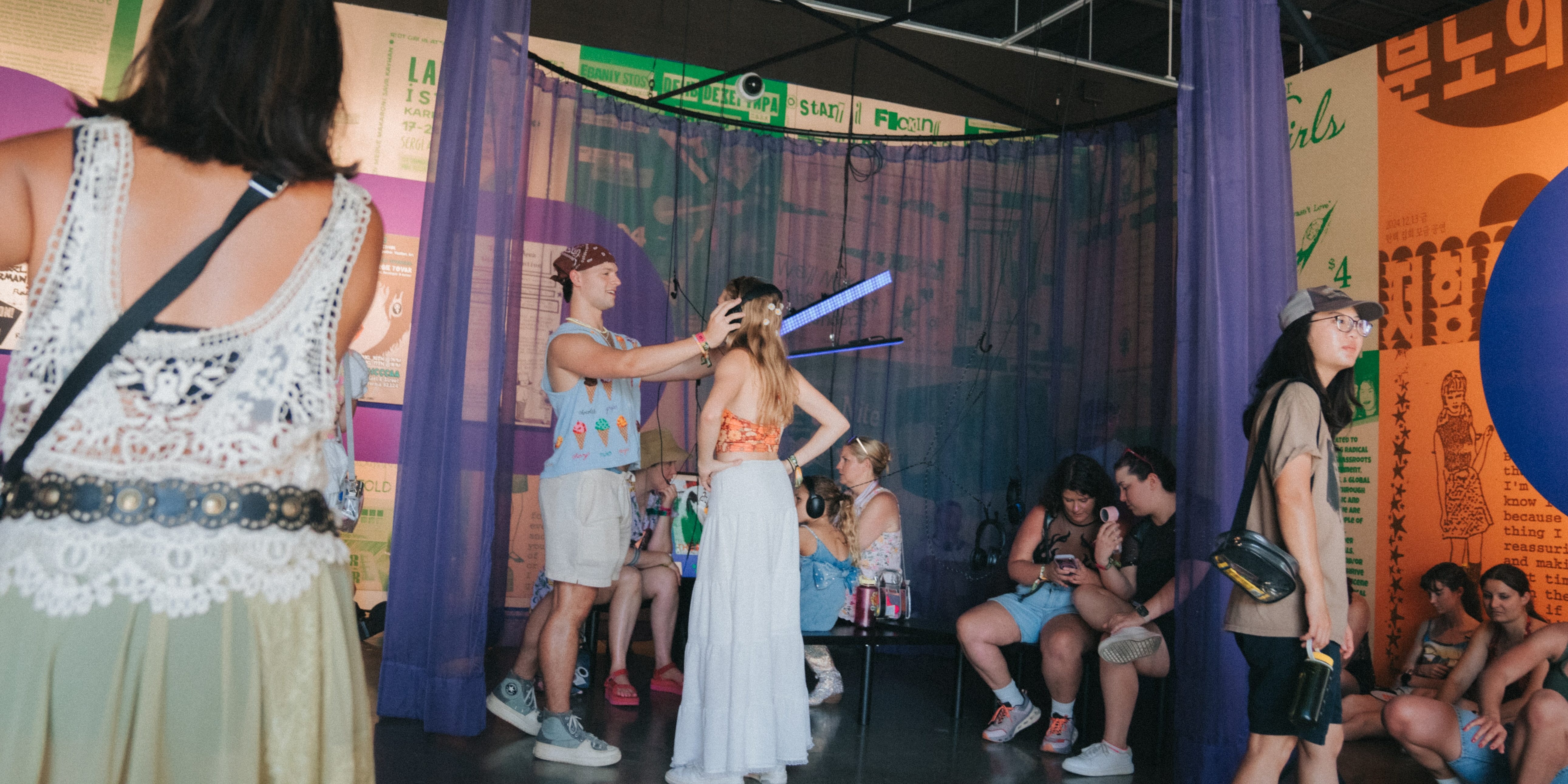
Just two or three months before the likes of Stevie Nicks, Chappell Roan, Bikini Kill, and Sarah McLachlan took the Daisy Chain stage and helped raise $20 million for nonprofit partners supporting women and girls, Suparak received the loose brief and got to work. Poring over old music reviews, abandoned Facebook and MySpace pages, and platforms such as Discogs and Bandcamp, she scoured the internet for bands who cited riot grrrl as an inspiration. She spoke with music labels in South Africa and rock clubs in Armenia, tracing the movement’s reach around the world. As part of the exhibit, Suparak expanded an interactive map, begun with “Alien She,” that lets visitors click on locations to learn more about local riot grrrl chapters and Ladyfest gatherings. Visitors can also submit information about chapters missing from the map.

The exhibition also features spaces full of handmade zines, flyers, music videos, and personal photographs from bands from different regions, immersing visitors in the creative output and political causes of varied communities. It is a love letter to the music and DIY spirit of riot grrrl in its many forms around the world, showing how a ’90s subculture became an international phenomenon whose ideas continue to inspire new generations of artists. Rodrigo herself, who previously told Pitchfork that she wanted Daisy Chain Fields to be part hippie “flower child,” part “riot grrrl punk,” is a proud member of this camp.
“One of the fun parts about researching for the exhibition was learning about musicians who proudly claim riot grrrl as an influence, but whose own music resides in other genres, like hip-hop and industrial and surf and Goth,” Suparak notes. “It’s cool to see how riot grrrl changes with each location and each era and what the political climate is. Like any social movement, it evolves. It’s not the same exact thing as it was in 1991 in the Pacific Northwest.”

Hi, Astria! First of all, how did this all come about?
Kathleen Hanna from Bikini Kill recommended me to Olivia Rodrigo. Olivia wanted to include an exhibition on riot grrrl at Daisy Chain Fields after finding out that there was a gallery on the vast, giant festival grounds. Kathleen knew about the riot grrrl exhibition that I had cocurated a decade prior. Olivia and her team looked at my past exhibition and thought I’d be a perfect fit.
With such a broad prompt, where did you go from there?
For “Grrrl Germs,” I wanted to focus on the music rather than contemporary art, because it’s part of a music festival. And I wanted to focus on the community-building and the activist nature of riot grrrl, especially in the context of a concert that’s fundraising and advocating for women and girls. And then, personally, I was interested in tracking the global impact of the movement, which is something that isn’t usually talked about.