I was familiar with the A’maree’s lore: A sprawling retail oasis in Newport Beach, California, built directly over the glimmering blue harbor; serotonin-boosting sunlight pouring through arched windows, bouncing from a gold sequin Bottega Veneta gown to an aspirational Dušan edit; three sisters running the boutique with friendly aplomb; and their mother, Nancy Brown—who founded the store 50 years ago—popping in to mingle with clients and dote on her daughters. But as I recently learned, visiting the if-you-know-you-know shop for the first time, the story of A’maree’s is about so much more than fancy clothes and the well-heeled Orange County women who can afford them.
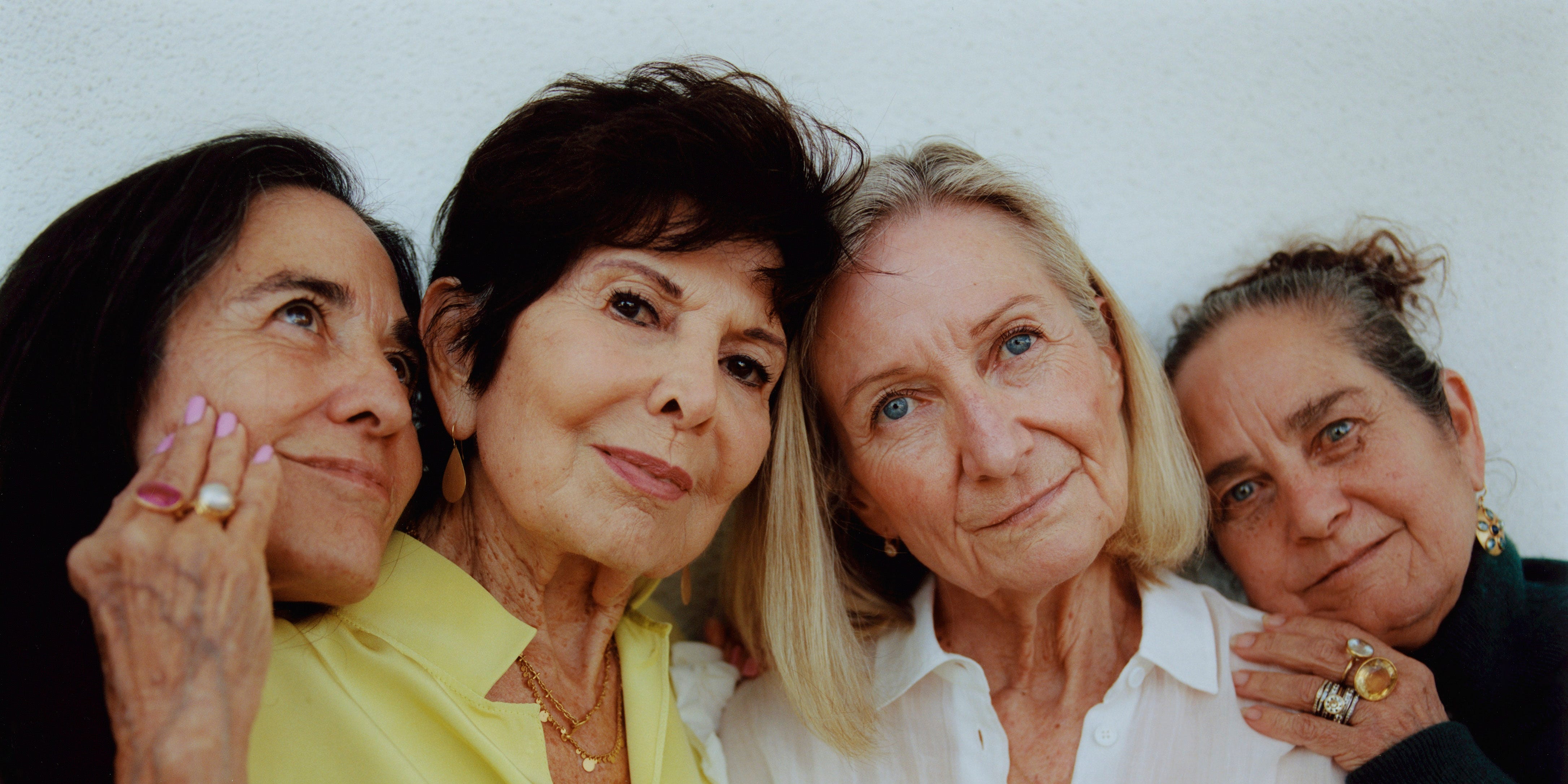
“I’m from Brooklyn, New York,” Nancy tells me, adding that she was lured to Newport by “the sunshine and palm trees.” She is wearing a silk pants set in bright pistachio by Zimbabwe-born L.A.-based designer Peter Cohen, and her three daughters—Apryl Schaefer, Dawn Klohs, and Denise Schaefer—sit on the curved cream couch next to her.
Before sitting down with the women, I quietly roam the boutique. I take in a selection of woven Alaïa flats before being distracted by a Jules Ten Velde ribbon dress. I prefer skirts to pants, but thumbing through a rack of colorful pieces by Gabriela Hearst, Issey Miyake, and Dries Van Noten, I’m halted by a pair of suede aquamarine Stouls trousers and think, I’d wear these. Walking the length of the store, past a glass case of shimmering Coady Cuhla diamond necklaces and under a custom Murano glass chandelier by Lucien Pellat Finet, I notice a pebble leather Valextra bag. I’ve never seen one with a mother-of-pearl closure, but that makes sense once I open it. Stamped inside are these words:
A’maree’s c. 1976 Serie Limitata 1/3


Nancy never dreamed of owning a store—much less one that a renowned Italian leather goods brand would craft limited-edition bags for if she simply asked. But we can rarely predict how life will unfold.
“When I married I was a homemaker, and I absolutely adored having three girls,” says Nancy, her passion for motherhood palpable. “I made them clothes, I decorated the house, I upholstered the furniture, I made the curtains… [and] it was really a dream for me.” Not one that would last forever, though. “Unfortunately I got a divorce. The divorce made me have zero; I had no child support, no alimony and no house.” But she did have “a wonderful, wonderful friend” named Ann Marie Hirsch, who purchased a storefront in a local strip center in 1976.
“She wanted a business but she didn’t want to work,” says Nancy. “It was a wonderful relationship because I could do whatever I wanted.” They named the store A’maree’s—a play on both Ann Marie and amare, which means “to love” in Italian—and filled it with classic American womenswear by Victor Costa, J.G. Hook, and Albert Nipon. Nancy was making $500 a week, and Apryl, Dawn, and Denise—who were 11, 13, and 15 at the time—would come by after school to help unpack boxes and steam garments. If Nancy needed to take one of them to the dentist or pick another one up from practice, she would ask whoever was shopping to keep an eye on the place. She worked at A’maree’s Monday through Saturday, and on Sunday, she baked chocolate chip cookies. She served them in the store on an English platter alongside a carafe of wine. “Ladies would come in and go, ‘I only want a little glass of wine and a cookie, but I’m not buying anything,’” Nancy remembers. “And then as they left writing a check for $2,000, they’d go, ‘Damnit!’”
A year after the store opened, TWA airline captain Floyd Brown walked in to buy a dress for his daughter. “We got married in 1980,” says Nancy. Prior to her first marriage, Nancy wanted to be a flight attendant. Instead, “I got to marry the captain and fly first class,” she says. “And then I had great clothes. It was like a dream made in heaven.” That dream was amplified when Nancy bought out Hirsch to assume full ownership of A’maree’s.
During the store’s infancy, Nancy and her daughters sourced the majority of its collections during market weeks in L.A. and Dallas. “Then we stepped out big time and started going to New York,” says Nancy. While the sisters were always asked to sit in the back during appointments to make room for buyers, they weren’t shy about asking questions once the models appeared.
“How are the buttonholes made?”
“What kind of fabric is that?”
“If we got that in navy, what would the buttons look like?”
Often, the same person who asked Apryl, Dawn, and Denise to move to the back would approach Nancy and say, “Would you bring your girls back up again?”
That curiosity never waned, which explains why the women, now 61, 63, and 65, have never had any other jobs besides their roles at A’maree’s. “I started out of desperation, but they continued out of passion,” Nancy says.
“I’ve always been into numbers,” says Apryl. “I do all the paperwork: I’m in the office all the time.” I suspect this before she tells me. The lone blonde among her brunette mother and sisters, she’s poised and affable, but happy to let others do the talking, opting to nod and smile in agreement through much of the conversation instead of interjecting.
“I do the buying with Dawn, and I come in every day and curate the store,” says Denise. “It’s an all-day-long, every day job, because there are a lot of moving parts. We have 100-plus collections, so there’s a domino effect.” (If the Rupert Sanderson slingbacks move to one surface, the Cecilie Bahnsen rack may have to shift as well.) In 2010, A’maree’s moved into the 8,300-square-foot space it occupies today, which was once the Stuft Shirt restaurant, designed by renowned architects Thornton Ladd and John Kelsey. Instead of doing a complete gut renovation, they kept much of the kitchen intact, using it to display homewares by Astier de Villatte, Échapper, and Julius; to chill the beverages they offer clients (sparkling water? still water? Diet Coke? Sprite?); and for chefs to use when they host parties, like the one taking place a few days after my visit to celebrate the store’s 50th anniversary and Nancy’s 87th birthday. Despite all that fills the boutique, “I’m always trying to make open space,” says Denise. “I think that’s such a luxury, seeing space instead of just a lot of product.”